Roob-la'aanta Honduras: Khasaare Beeraha ah oo Reer Galbeedka Dry Corridor Ku Dhacay Julaay 2026
Falanqaynta xaaladda cuntada iyo waxsoosaarka iyadoo loo eegayo illaa Janaayo 2027
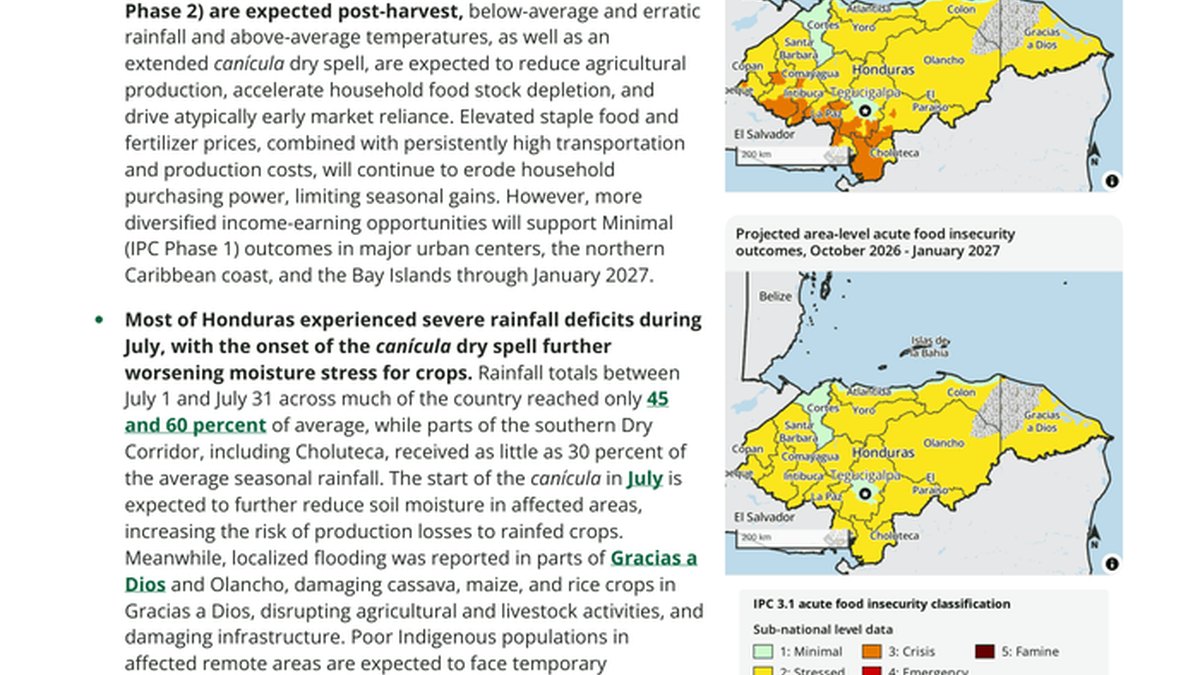
Inta badan Honduras waxaa laga filayaa inay ku sii jirto Marxaladda 2-aad (IPC Phase 2) ilaa Janaayo 2027, halka qoysaska saboolka ah ee Dry Corridor iyo xeebta Choluteca ay la kulmi doonaan Crisis (IPC Phase 3) ilaa Sebtembar 2026. Magaalooyinka waaweyn waxaa taageeray dakhliyo kala duwan.
Deficitka Roobka iyo Khasaaraha Beeraha
Inta badan Honduras waxay la kulantay hoos-u-dhac baahsan oo roob ah bishii Julaay 2026. Wadar roobka intii u dhaxaysay 1 ilaa 31 Julaay waxay gaartay kaliya 45 ilaa 60 boqolkiiba celceliska, sida ay sheegayaan xogta.
Qaybo ka mid ah koonfurta Dry Corridor, oo ay ku jirto Choluteca, waxay heleen 30 boqolkiiba roobka xilliga ah. DICTA-SAG waxay xaqiijisay in "poor rainfall and prolonged dry spells disrupted primera planting and crop development across several production areas" (c6, q1).
Beddelka Dalagga iyo Qiimaha Sarrifka
Qiyaastii 12,532 manzanas (8,772 hectares) oo galley ah iyo in ka badan 4,400 manzanas (3,080 hectares) oo digir cas ah ayaa lumay xaaladaha cimilada oo xun illaa Julaay. Khasaaradu waxay urursan tahay Lempira, Ocotepeque, Intibucá iyo Comayagua.
Bishii Juun, qiimaha NPK 12-24-12 wuxuu ahaa 28.2 boqolkiiba ka sarreeya sannadkii hore, halka urea ay ahayd 73.3 boqolkiiba ka sarreeya. Kharashka gaadiidka wuxuu kor u kacay 15 boqolkiiba, taasoo qiimaha cuntada kordhisay.
Saamaynta Suuqa iyo Qiimaha Cuntada
Bishii Juun, qiimaha galleyda cad wuxuu ahaa 30.8 boqolkiiba ka sarreeya sannadkii hore iyo 35.4 boqolkiiba celceliska shan sano. Yaqaannada ayaa xusay in hoos-u-dhaca waxsoosaarka gudaha uu sii wado qiimaha sare.
Digirta cas waxay qiimaheedu kordhay 5.5 boqolkiiba marka loo eego May wuxuuna ahaa 9.1 boqolkiiba ka sarreeya celceliska shan sano. Waxsoosaarkii sannadihii la soo dhaafay ayaa sii hayay qiimaha sare ee suuqa.
Honduras faced severe rainfall deficits in July 2026, with much of the country receiving only 45 to 60 percent of average rainfall, while the southern Dry Corridor saw as little as 30 percent. The resulting crop losses and elevated input costs are pushing vulnerable households toward crisis-level food insecurity through September 2026.
Rainfall Shortfalls and Crop Damage
Most of Honduras experienced severe rainfall deficits during July, with totals between July 1 and July 31 reaching only 45 and 60 percent of average across much of the country. Parts of the southern Dry Corridor, including Choluteca, received as little as 30 percent of the average seasonal rainfall, while some areas endured up to 22 days without rain. The onset of the canícula dry spell further worsened moisture stress for crops, increasing the risk of production losses to rainfed agriculture.
According to the Secretariat of Agriculture and Livestock (DICTA-SAG), poor rainfall and prolonged dry spells disrupted primera planting and crop development across several production areas. Significant delays in rainfall onset across the southwestern Dry Corridor forced many farmers to postpone planting until soil moisture conditions improved, including into July in parts of Copán and other western departments.
Crop Losses and Rising Input Costs
Crop losses have been concentrated in the Dry Corridor, particularly across Lempira, Ocotepeque, Intibucá, and Comayagua. As of July, approximately 12,532 manzanas (8,772 hectares) of maize and more than 4,400 manzanas (3,080 hectares) of red beans were lost due to adverse weather conditions. Meanwhile, localized flooding was reported in parts of Gracias a Dios and Olancho, damaging cassava, maize, and rice crops in Gracias a Dios.
Above-average fertilizer prices have increased production costs during primera planting, limiting input use among poor subsistence farmers. In June, NPK 12-24-12 prices were 28.2 percent above last year and 23 percent above the five-year average, while urea prices were 73.3 percent above last year and 62.2 percent above the five-year average. These elevated costs, combined with erratic rainfall, have likely limited application rates among smallholder farmers and constrained crop development.
Food Price Inflation and Humanitarian Outlook
Staple food prices remain above average during the lean season. In June, white maize prices remained 30.8 percent above last year and 35.4 percent above the five-year average, while red bean prices rose 5.5 percent compared to May and remained 9.1 percent above the five-year average. Persistently high fertilizer prices are expected to increase production costs for the upcoming postrera season, further eroding household purchasing power.
Most of Honduras is expected to remain Stressed (IPC Phase 2) through January 2027, while poor households in the Dry Corridor and the Pacific coastal region of Choluteca will continue to face Crisis (IPC Phase 3) outcomes through September 2026. However, more diversified income-earning opportunities will support Minimal (IPC Phase 1) outcomes in major urban centers, the northern Caribbean coast, and the Bay Islands through January 2027.