Qaramada Midoobay: Xaaladda Amniga iyo Biyaha Soomaaliya Waa Mid Daciif ah
Bishii Juun ee 2026, Qaramada Midoobay waxay sheegtay in Soomaaliya ay ku jirto xaalad adag oo ku saabsan biyaha iyo amniga, iyadoo 17,620 qof ay ka carureen guryahooda, halka 1,878 qofna ay ku sugnaayeen khataro amni oo kala duwan.
Khataraha Amniga iyo Xaaladda Qaxootiga
Bishii Juun ee 2026, Soomaaliya waxay ku qabatay 17,620 qof oo ka caruuray guryahooda, iyadoo sababta ugu weyn ay ahayd dagaal iyo amni darro (45%), halka qorrax-dhacna uu ahaa 32%.
Sidoo kale, 1,878 qof ayaa ku sugnaa khataro amni oo kala duwan, taasoo muujinaysa in la baaro amniga, la xaqiijiyo xiriirka, la maareeyo xaaladda, la tusaalo-geliyo, iyo in la taageero dadka ugu daran.
Xaaladda Biyaha iyo Khataraha Biyaha
Qaramada Midoobay waxay sheegtay in 38 shirkadood oo ka mid ah shirkadaha biyaha ay sheegeen in 73% ka mid ah mashruuca ay ku jiraan khatar ah inay dib u furmaan haddii aan la helin biyo.
Sidoo kale, 60% ka mid ah shirkadaha ayaa sheegay inay uusan hayn biyo degdeg ah oo loo isticmaali karo xaaladaha degdegga ah, taasoo muujinaysa in la baaro biyaha.
Xaaladda Biyaha iyo Khataraha Biyaha
Qaramada Midoobay waxay sheegtay in 38 shirkadood oo ka mid ah shirkadaha biyaha ay sheegeen in 73% ka mid ah mashruuca ay ku jiraan khatar ah inay dib u furmaan haddii aan la helin biyo.
Sidoo kale, 60% ka mid ah shirkadaha ayaa sheegay inay uusan hayn biyo degdeg ah oo loo isticmaali karo xaaladaha degdegga ah, taasoo muujinaysa in la baaro biyaha.
Somalia's Protection and WASH Clusters reported critical challenges in July 2026, with 17,620 new internally displaced individuals and severe underfunding threatening ongoing humanitarian operations across the country.
Displacement and Protection Risks Rise Amid Conflict and Drought
In July 2026, Somalia recorded 17,620 internally displaced individuals, mainly due to conflict and insecurity (45%), drought (32%), and other causes (23%). Additionally, 1,878 individuals were exposed to protection risks, underscoring the urgent need for sustained monitoring, safe referrals, case management, and targeted life-saving assistance.
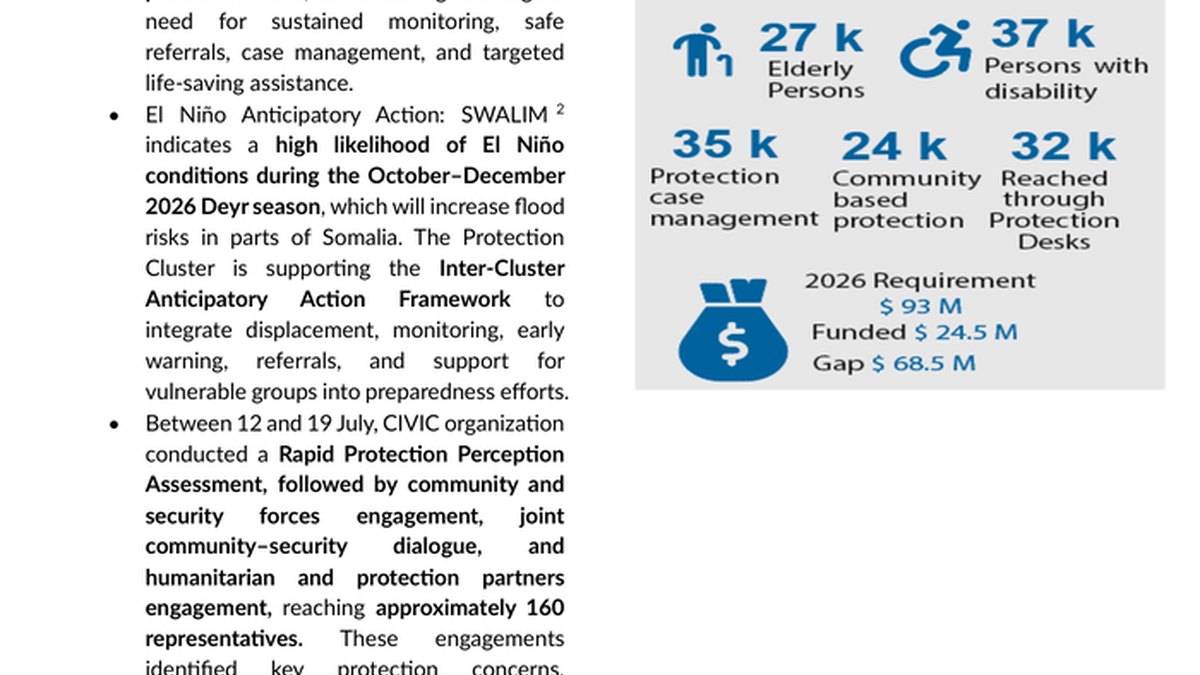
Protection partners assisted 15,628 individuals with specialized protection services, demonstrating the continued relevance and lifesaving value of dedicated protection programming in Somalia. Through community-based protection, community self-protection initiatives, psychosocial support, individual protection assistance in cash and in-kind, supported referrals, and protection case management, partners helped affected people reduce exposure to violence, coercion, exploitation, abuse, and deliberate detentions.
WASH Cluster Struggles with Funding Shortfalls and Supply Constraints
The May 2026 WASH Cluster partner survey, completed by 38 partners, points to a widening gap between operational capacity and available resources. Nearly three quarters of respondents reported inadequate confirmed funding for 2026: 39% were only partially funded (US$1.3 million) and 33% had no confirmed WASH funding, while just 28% reported confirmed funding, amounting to approximately US$4.5 million.
73% of respondents indicated that their projects faced a risk of closure within three to six months if additional resources were not secured. Supply readiness is constrained, with 60% of respondents reporting that they do not hold emergency WASH supplies to respond to a new crisis, increasing reliance on the WASH Cluster supply mechanism, supported by UNICEF in its role as Provider of Last Resort.
El Niño Looms as Climate Threat While Humanitarian Reach Falls Short
SWALIM indicates a high likelihood of El Niño conditions during the October–December 2026 Deyr season, which will increase flood risks in parts of Somalia. The Protection Cluster is supporting the Inter-Cluster Anticipatory Action Framework to integrate displacement, monitoring, early warning, referrals, and support for vulnerable groups into preparedness efforts.
By July 2026, WASH partners had reached approximately 1 million people, out of the 2.23 million annual targets. The activities most frequently identified as affected by underfunding were water supply, sanitation, and hygiene kits distribution.