
Qaramada Midoobay waxay bilaabaysaa Midnimo Caalami ah oo lagu horumariyo waddamada daciifka ah
Qaramada Midoobay ayaa maanta ku dhawaaqday inay 12-kii September 2026 ku xusayso Maalinta Qaramada Midoobay ee Iskaashiga Waqooyiga iyo Waqooyiga, iyadoo lagu soo bandhigayo Midnimada Caalamiga ah ee Iskaashiga Waqooyiga iyo Waqooyiga.
Midnimada Caalamiga ah iyo Iskaashiga Waqooyiga
Midnimada Caalamiga ah ee Iskaashiga Waqooyiga iyo Waqooyiga ayaa ah barnaamij awood leh oo lagu horumariyo waddamada daciifka ah, kaas oo ka kooban dowladaha, hay'adaha Qaramada Midoobay, iyo shirkadaha ganacsiga.
Iskaashiga Waqooyiga iyo Waqooyiga wuxuu ka kooban yahay iskaashiga dowladaha waqooyiga ah ee dowladaha waqooyiga ah, iyadoo la raacayo xeerarka dhaqanka, xeerka, iyo faa'iidada midaysan.
Faa'iidada Iskaashiga Waqooyiga iyo Waqooyiga
Dr. Abdullah Bandar Al Otaibi ayaa sheegay in Midnimada Caalamiga ah ay ka dhacday waqtiga ugu muhiimsan ee dhaqaalaha, isbeddelka cimilada, iyo lacagta horumarinta.
Wuxuu intaas ku daray in Midnimada Caalamiga ah ay u ogolaan karto waddamada daciifka ah inay beddelaan awooddooda si ay u sameeyaan mashruucyo dhab ah, iyadoo la isticmaalo lacagta saddexaad.
Dhaqaalaha Waqooyiga iyo Waqooyiga
Dr. Abdullah Al Khater ayaa sheegay in Midnimada Caalamiga ah ay ka dhacday waqtiga ugu muhiimsan ee dhaqaalaha, isbeddelka cimilada, iyo lacagta horumarinta.
Wuxuu intaas ku daray in Midnimada Caalamiga ah ay u ogolaan karto waddamada daciifka ah inay beddelaan awooddooda si ay u sameeyaan mashruucyo dhab ah, iyadoo la isticmaalo lacagta saddexaad.
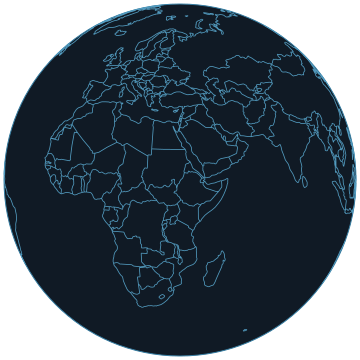
The United Nations will mark UN Day for South-South Cooperation on September 12, 2026, with the launch of the Global Alliance for South-South and Triangular Cooperation, a voluntary mechanism designed to scale proven development solutions across the Global South.
A New Framework for Peer-Led Development
The 2026 observance signals a major milestone, introducing a voluntary mechanism coordinated by the UN Office for South-South Cooperation (UNOSSC) that brings together member states, UN entities, multilateral financial institutions, academia, and the private sector. The initiative precedes the High-Level Week of the 81st Session of the UN General Assembly, which Secretary-General António Guterres said aims to revitalize global cooperation and accelerate progress toward the Sustainable Development Goals.
Rooted in the founding of UNOSSC in 1974 and the 1978 Buenos Aires Plan of Action, the framework complements traditional North-South aid while strictly adhering to principles of national sovereignty, non-conditionality, equality, and mutual benefit. Triangular cooperation involves South-led partnerships supported by developed nations or multilateral organizations to implement joint development initiatives.
Strategic Value at a Critical Juncture
Dr. Abdullah Bandar Al Otaibi, Assistant Professor of International Affairs at Qatar University, told QNA that the Alliance arrives at a critical juncture marked by rising debt, climate pressures, and shrinking development funds. He emphasized that the platform allows developing nations to translate their expertise into concrete projects while leveraging third-party financing and retaining full ownership over their developmental priorities.
Dr. Al Otaibi noted that Gulf economies, particularly Qatar, are uniquely positioned to combine financing, investment, and knowledge transfer across key sectors. The most immediate beneficiaries will likely be food security, water management, clean energy, and digital technology, spanning areas such as drought-resistant agriculture, desalination, renewable energy efficiency, e-governance, and artificial intelligence applications in health and disaster management.
Economic Momentum and Market Realities
Economist Dr. Abdullah Al Khater told QNA that the primary economic value of the Global Alliance lies in bridging the gap between demand and supply by linking expertise, capital, and market needs through a unified, effective network. He explained that the platform provides incentives for real participation rather than symbolic membership, dramatically reducing search costs, time, and effort among funding institutions, investors, and projects.
Dr. Al Khater stressed that adopting modern technology will minimize capital expenditures and improve returns, offering clear performance metrics for investors. To prevent the platform from becoming a political or promotional venue, he urged for transparent reporting, competitive performance tracking, and the active inclusion of the private sector as a neutral, market-driven third party, backed by specialized managerial oversight.
Ilaha iyo xuquuqda sawirka
Sawir: Qatar News Agency General Xigasho